
When organizations begin planning a legacy system retirement, the conversation usually arrives at the same destination: data migration. The plan is to move the records, rebuild the logic, and stand up something new that replicates what the old system did. The assumption behind that plan is that the work still needs to be done, that the value sitting in the legacy system is somehow incomplete or inaccessible in its current form and must be reconstructed before it can be used.
That assumption is worth examining closely, because for most regulated organizations, it is wrong.
The legacy system already did the hard work. It ingested decades of records, applied the business rules, generated the reports, and produced the outputs your organization has depended on through regulatory examinations, agency audits, and operational cycles you may not be able to count. Those outputs exist right now, in finished form, ready to be accessed. The question is not whether that work needs to be redone. The question is why so many organizations default to redoing it anyway, and what a better path forward looks like.
What the Legacy System Already Produced
A legacy system in a regulated environment is the accumulated output of years of transactions, calculations, and compliance-grade record generation, and it is considerably more than a database. A bank running their banking system has monthly customer statements, financial reports, period-end packages, and exception reports that reflect every rule the system applied at the time each document was created. A federal contractor’s legacy records management platform holds information that satisfied specific regulatory retention requirements when it was generated. A healthcare organization’s aging archive contains records that were compliant with HIPAA requirements at the time of creation and remain subject to retention obligations that have not expired.
That information is fixed and finished. It represents the output of business logic that was validated, audited, and relied upon when it was produced. The formatting is correct. The calculations have already been applied. The regulatory requirements that governed each document were already in effect when the system generated it.
When an organization migrates at the database level, it takes that finished work and attempts to reconstruct it from raw components in a new environment, which means replicating business rules that may not be documented, reformatting outputs to match the original presentation, and running validation cycles to confirm that the reconstructed version matches what the original system produced. That process is expensive, time-consuming, and rarely achieves a clean match on the first attempt.
Information-level archiving starts from a different premise: capture what the system already produced, preserve it in that finished state, and make it accessible without recreating any of the underlying work.
The Reconstruction Problem
The cost of recreation is worth understanding in concrete terms, because it shows up in every legacy system decommissioning project that defaults to the database migration path.
Legacy systems, particularly those that have been running for ten years or more, accumulate logic that is not visible in the underlying information. Report formatting rules, rounding conventions, account-specific calculation methodologies, and compliance-required field definitions exist in code and configuration files that were written by developers who may no longer be available. When those rules are not documented, the migration team has two options: reverse-engineer the logic from the outputs, or accept that the new system will produce results that do not precisely match the old one.
Neither option is free. Reverse-engineering embedded logic is slow, painstaking work that adds months to migration timelines and cost to migration budgets. Accepting imprecise replication creates audit exposure, because a regulator or examiner asking for a specific report from a specific period is asking for the record as it existed, and a close approximation does not satisfy that request.
The organizations that run into this wall most often are organizations that are heavily regulated, where system-generated reports carry specific formatting requirements embedded deep in system configuration. They are also organizations in government and defense contracting that hold decades of records across systems built to specifications that no longer exist in readable documentation. And they are the healthcare organizations with patient record archives in systems that predate modern information architecture by fifteen years or more.
In each case, the legacy system already produced correct, compliant, usable information. The migration plan proposes to discard that work and reproduce it. The argument for doing so rarely holds up when the full cost of reconstruction is on the table.
What Regulators and Examiners Are Asking For
Understanding why information-level archiving is a better fit for most regulated organizations starts with understanding what compliance demands.
Regulators do not ask for database exports. An agency examiner conducting a regulatory audit or review asks to see specific correspondence, specific monthly statements, and specific financial reports from specific time periods. An auditor asks for the period-end package as it was distributed. A federal agency conducting a records review asks for the document as it was produced and retained.
What each of those requests has in common is that the examiner is asking for the output, the finished document in the form it existed when the obligation was satisfied. A database export, even a complete and accurate one, does not answer that question. It answers a different question: what were the underlying records? Getting from a database export to the finished document requires applying all of the logic the original system used, which is precisely the reconstruction problem described above.
An information archive answers the examiner’s question directly. The document exists in finished form, tamper-proof and permanently retained, retrievable in seconds rather than hours. There is no reconstruction required and no risk that the retrieved document differs from what was produced at the time. The record is the record.
For organizations subject to regulatory oversight, audit obligations, or federal records retention mandates, that distinction is not an operational detail. It is the difference between a clean audit response and one that requires explanation.

The IT Overhead Question
Beyond the compliance argument, there is a straightforward operational argument for archiving at the information level rather than migrating at the database level.
Database migrations require significant IT involvement throughout the project and often for years afterward. The new system needs to be stood up, configured, validated, and maintained. The migration process itself generates questions that require technical resources to answer. And when the new environment carries legacy information, someone in IT is responsible for ensuring that information remains accessible, secure, and compliant over time.
OCIE’s managed service model removes that burden. The archive is hosted, maintained, secured, and supported by OCIE. There is no software to install, no infrastructure to manage, and limited internal IT burden after the initial ingestion. When an examiner asks for a ten-year-old report, the operations team pulls it in seconds from a browser-based interface without involving IT at all.
That is a description of what changes operationally when an organization stops maintaining a legacy system and starts accessing a managed archive. The legacy system carries costs: server infrastructure, licensing, contractor retainers for institutional knowledge, IT hours spent on maintenance that generates no new value. A managed archive carries a flat monthly rate with no built-in increases, no storage overages, and no hidden per-retrieval fees.
For mid-market organizations in regulated industries, the carrying cost of a legacy system that generates no new business value but cannot be shut down for compliance reasons is a well-understood problem. The solution is to archive its outputs and retire the infrastructure.
When Migration Still Makes Sense
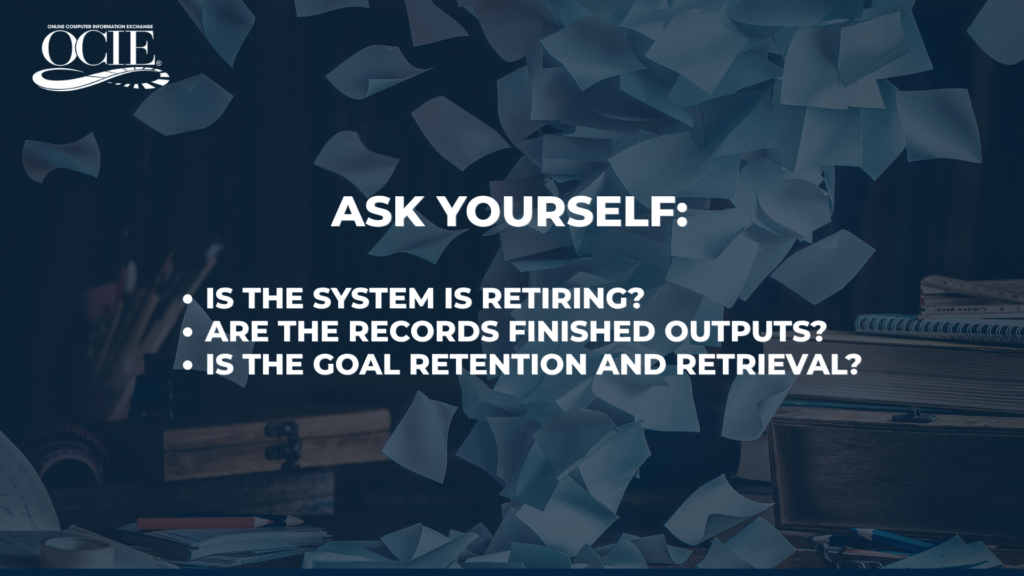
Information-level archiving is the right approach for a specific set of circumstances: the organization needs to preserve access to historical records from a system it is retiring, the records are in the form of system-generated outputs rather than live transactional information, and the compliance obligation is for retention and retrieval rather than ongoing processing.
There are circumstances where database migration remains the appropriate path. If the organization needs to continue processing transactions against historical records in a new system, migration may be required to support that processing. If the legacy system is being replaced by a platform the organization will actively use going forward and that platform requires the historical information to function, migration is worth the investment.
The distinction matters because these two scenarios are often conflated in migration planning conversations. An organization that needs to retire an unsupported system and preserve access to historical financial statements for regulatory retention purposes has a fundamentally different problem from an organization that needs to migrate active account information into a new system platform. The first problem calls for information archiving. The second calls for migration. Running the second solution on the first problem adds months and cost to a project without improving the outcome.
Working through which scenario applies is a focused conversation. The answers change the scope, the budget, and the timeline of the project in ways that are worth understanding before a contract is signed.
Thirty Years of Outputs Worth Keeping
OCIE has worked with organizations in mortgage servicing, federal government, and financial services for over 30 years. The pattern we see consistently is that the legacy system represents more value than the organization realizes at the moment of retirement. The information in that system was generated correctly, retained compliantly, and relied upon through regulatory events and business cycles. It deserves to be preserved with the same care that went into producing it.
What it does not deserve is to be dissolved into a migration project that attempts to recreate it from raw components in a new environment, at significant cost and risk, when the finished product already exists.
If your organization is approaching a legacy system retirement and the conversation has been centered on migration options, it may be worth stepping back to ask a simpler question: what has this system already produced, and what would it take to keep that information exactly as it is? In most cases, the answer is more straightforward than the migration plan suggests. If any of this resonates, let’s get on a call.
OCIE is a managed information service built for regulated industries. We help organizations retire legacy systems, preserve audit-ready records, and eliminate the compliance exposure that comes with keeping aging platforms on life support. Learn more about our approach.